
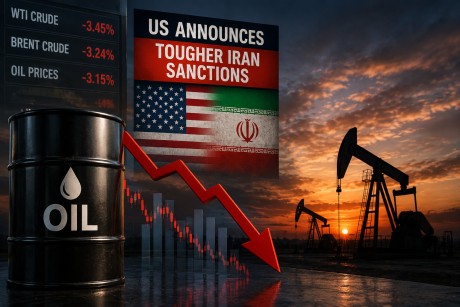
On Tuesday, oil prices tumbled over 3%, hitting their lowest point in a week as investors weighed the implications of new U.S. sanctions on Iran. Brent crude, serving as the global benchmark, dropped 3.1% to settle at $89.31 per barrel. Meanwhile, West Texas Intermediate (WTI) saw a 3.34% decline, bringing it down to $82.17 per barrel. This downturn followed a period of robust gains the previous week, where Brent surged by 6.6% and WTI by 5.7%.
The United States has intensified its sanctions regime against entities and nations engaging economically with Iran, aiming to exert greater pressure on Tehran amidst ongoing tensions. These measures are part of a broader strategy to destabilize Iran’s economy. Despite the escalating geopolitical risks, particularly around the strategically crucial Strait of Hormuz, oil traders are primarily focused on how these new sanctions might impact Iranian oil exports.
The Strait of Hormuz remains a significant concern as it is a vital conduit for global energy supplies. Iranian officials have issued warnings that should the U.S. continue to ramp up pressure, they could potentially halt oil exports through this critical waterway. This has added another layer of complexity to the already volatile oil markets.
Further adding to the uncertainty, shipping risks have risen with reports of a tanker being struck near Oman’s Musandam peninsula. Additionally, ongoing attacks in the Red Sea have compounded worries about the stability of global energy supplies.
Despite these geopolitical tensions and risks to shipping routes, the focus for traders remains on the potential repercussions of the new U.S. sanctions on Iran. They are assessing the extent to which these sanctions might disrupt Iranian oil exports and, consequently, affect the global oil supply chain.