
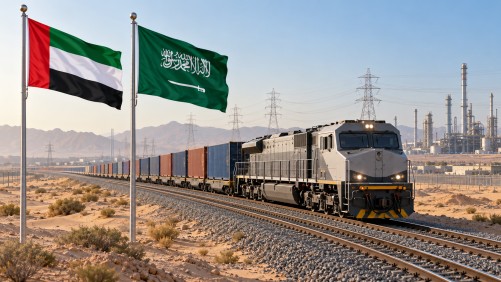
The United Arab Emirates and Saudi Arabia have signed a Memorandum of Understanding (MoU) aimed at enhancing rail connectivity and energy cooperation between the two nations. The agreement, formalized in Riyadh, involves UAE Minister of Investment Mohamed Hassan Alsuwaidi and Saudi Arabia’s Minister of Energy, Prince Abdulaziz bin Salman bin Abdulaziz. This MoU seeks to foster economic development and regional connectivity through improved infrastructure and trade relations.
Central to the agreement is the exploration of potential rail links between the UAE and Saudi Arabia, which are expected to streamline the movement of goods and cargo across their borders. Technical and economic evaluations will be conducted to identify opportunities for optimizing logistics networks, enhancing supply-chain efficiency, and facilitating cross-border transportation. This initiative is anticipated to bolster trade and economic cooperation between the neighboring countries by making goods transport more efficient.
Beyond rail infrastructure, the agreement also covers the field of electricity interconnection. The MoU outlines plans for technical, economic, and environmental feasibility studies to assess the potential for expanding electricity links between the two nations. This aspect of the agreement aims to facilitate the exchange and sale of electricity, contributing to a more integrated energy system.
The agreement further includes provisions for coordination with other Gulf Cooperation Council (GCC) member states to enhance the regional electricity interconnection network. This initiative is designed to improve the efficiency of energy systems, strengthen regional cooperation, and support the long-term development of infrastructure across the Gulf region.
Overall, the MoU between the UAE and Saudi Arabia represents a strategic effort to improve connectivity and cooperation in both rail and energy sectors, with the potential to significantly impact economic growth and regional integration in the Gulf. The collaboration highlights the commitment of both countries to pursue shared goals in infrastructure development and energy efficiency.