
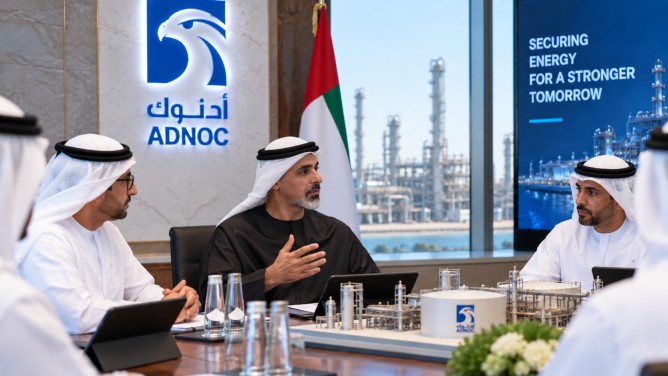
Amid rising uncertainties in global energy markets, Abu Dhabi Crown Prince Sheikh Khaled bin Mohamed emphasized the pivotal role of the Abu Dhabi National Oil Company (ADNOC) during a recent meeting. Presiding over the ADNOC Executive Committee of the Board of Directors at its headquarters, Sheikh Khaled examined the company’s operational and financial health. He also discussed strategies to ensure stable energy supplies, especially given recent disruptions in maritime navigation in the region.
Sheikh Khaled directed ADNOC to bolster its status as a comprehensive energy firm by integrating its production, trading, and logistics operations. He emphasized the necessity for operational flexibility and the importance of the company’s integrated capabilities to meet evolving customer needs. This directive comes as part of efforts to enhance ADNOC’s responsiveness to dynamic global energy conditions while ensuring continuous and secure supplies to its clients.
During the meeting, Sheikh Khaled received updates on ADNOC’s global liquefied natural gas (LNG) marketing and trading platform, which was launched in July. The platform is designed to expand ADNOC’s gas portfolio, targeting an output of 47 million tonnes per annum of marketable LNG by 2030. This expansion is expected to provide more supply options for customers and solidify ADNOC’s position in the global energy market.
Prior to the meeting, Sheikh Khaled toured ADNOC’s emergency control center, where he engaged with employees and business continuity teams. These teams are critical in ensuring safe and efficient operations during potential disruptions, underscoring the company’s commitment to maintaining reliability even in challenging situations.
The discussions at the meeting focused on fortifying ADNOC’s capabilities to adapt to shifting global energy scenarios, reinforcing its commitment to delivering dependable energy solutions amidst changing conditions worldwide. Sheikh Khaled’s directives reflect a strategic approach to positioning ADNOC as a global leader in energy resilience and supply reliability.