
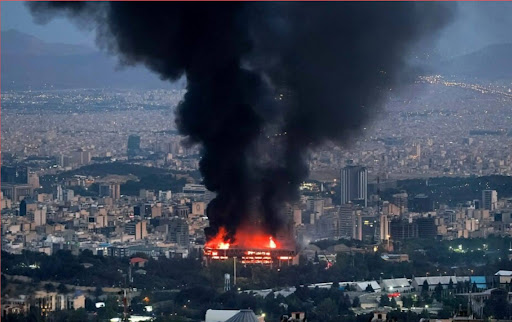
Iran demonstrated its capacity for simultaneous multi-front military operations on Saturday, firing ballistic missiles at the UAE while continuing rocket attacks on Israel and threatening to strike any Gulf energy facility with American connections. The display of coordinated offensive capability challenged claims by US officials that Iran’s military was on the verge of collapse, and underscored the assessment of independent analysts that the Islamic Republic retained significant fighting strength despite weeks of intensive US and Israeli bombing.
The missiles that struck the UAE’s Fujairah emirate forced a suspension of oil-loading operations at one of the world’s most important ship-refuelling ports and sent dark smoke rising over the coastline. Iran’s military warned civilians near UAE ports and US installations to evacuate, signalling that more strikes were possible. The attack was part of Iran’s strategy of inflicting economic damage on US allies to pressure Washington into halting its offensive. Iran’s foreign minister simultaneously called on Arab states to expel US forces from the region.
The United States pressed on with its air campaign, bombing Kharg Island on Saturday for the second consecutive day. President Trump said in public remarks the island had been effectively demolished and called on allied nations to send warships to the Strait of Hormuz, which Iran had blocked since February 28. He named China, France, Japan, South Korea, and the UK. His appeal was the first public acknowledgment that the US might need multinational help to reopen the waterway. Energy prices were near $120 per barrel, threatening to go higher.
Israel conducted dozens of airstrikes inside Iran, killing at least 15 people in an Isfahan factory. Iran fired rockets at Israel in return. US Defence Secretary Pete Hegseth claimed Iran’s leaders were “desperate and hiding” underground and said the new supreme leader had been wounded. Iranian officials confirmed Khamenei’s injury but called it minor. The International Crisis Group said the regime remained structurally intact and was executing a deliberate strategy of survival, retaliation, and prolonged conflict.
The human toll of the war was mounting. More than 1,400 Iranians had been killed in sustained bombing. Thirteen Israelis and roughly 20 Gulf residents had died. Lebanon’s crisis deepened, with 800 killed and 850,000 displaced from Israeli strikes on Hezbollah. Six US troops died in an aircraft crash in western Iraq. The US embassy in Baghdad was struck by missiles, and Americans throughout Iraq were ordered to leave immediately. Iran’s ability to strike simultaneously on multiple fronts suggested the conflict had considerable distance yet to run.