
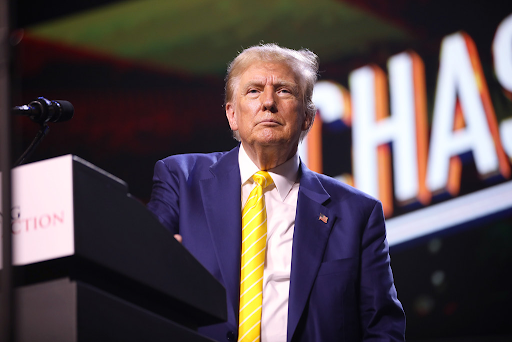
President Trump framed his announcement of a 15% universal tariff Saturday not as a legal workaround but as a moral mission — a vow that the era of foreign nations taking advantage of the United States in trade was permanently over. The declaration came hours after the Supreme Court struck down his previous tariff authority, but Trump showed no intention of retreating.
Posting on Truth Social, Trump wrote that he was raising the tariff to “the fully allowed and legally tested 15% level,” citing Section 122 of the Trade Act of 1974. This provision, which has never been used before, allows the president to impose tariffs of up to 15% for 150 days without congressional approval. After that, legislative authorization is required, and Trump’s team has pledged to use the window to craft durable long-term policy.
The Supreme Court had ruled 6-3 on Friday that Trump’s use of the IEEPA was unconstitutional, requiring congressional sign-off he had not obtained. Trump labeled the ruling “ridiculous” and attacked the justices personally. His own nominees, Barrett and Gorsuch, bore the brunt of his public fury — he called them an “embarrassment to their families” and said they were “barely” invited to the upcoming State of the Union address.
European leaders pushed back sharply. Germany’s Merz called tariff volatility “poison” for transatlantic economies and announced a trip to Washington to present a joint EU position. France’s Macron invoked the importance of judicial independence and called for trade reciprocity rather than unilateral presidential decisions. The UK, which had negotiated a 10% deal, now faces the new 15% baseline with fresh uncertainty about the road ahead.
American businesses and consumers have already paid roughly 90% of the more than $130 billion collected in tariffs under the now-invalidated IEEPA framework. The new 15% rate, with exemptions for critical minerals, metals, pharmaceuticals, and USMCA-compliant goods, promises to extend that domestic burden. Sector-specific tariffs on steel, aluminum, lumber, and autos remain fully in force regardless of the court’s ruling.